


in Public Cloud
Intercompany reconciliations are among the most time-consuming tasks in finance. Differing posting rules, inconsistent data quality, and manual reconciliations regularly lead to delays in closing the period. With SAP Intercompany Matching and Reconciliation (ICMR), SAP provides a modern, integrated solution that automates, standardizes, and significantly accelerates this process.
Business Drivers and Motivation
SAP Intercompany Matching and Reconciliation helps companies address the typical challenges that arise when reconciling intercompany transactions:
High costs due to inefficiencies in the coordination process
Delays in voting due to significant communication efforts
Requires many ETL processes; no real-time synchronization
No standardized reporting; no standardized reporting platform
IT support is needed to adapt the methods and rules
There is a lack of group-wide standardized processes for coordinating IC data
Overview of SAP ICMR in the Public Cloud
Verfügbarkeit
ICMR has been available since the early release versions of SAP S/4HANA Cloud and is continuously updated and enhanced as part of the quarterly innovation cycle. This means that companies automatically benefit from improvements and new features—without having to undertake their own upgrade projects.
Applications
SAP ICMR is highly flexible and supports a variety of requirements in the area of intercompany reconciliation. It can be used in SAP S/4HANA both in the General Ledger and in Group Reporting. While it is used for consolidation in Group Reporting, this article deliberately focuses on its application in the General Ledger—that is, where intercompany postings are generated and can be reconciled in real time.

Licensing
In the public cloud, ICMR is typically included in the SAP Finance suite of functions within the general ledger. Its use in Group Reporting is tied to the corresponding Group Reporting license.
Objective of the solution
- Reduction in manual reconciliation and communication efforts
- Real-time visibility into all intercompany differences
- Acceleration of the closing process
- Consistent rules and processes across all companies
Key Functions of SAP ICMR in the General Ledger
Why ICMR Is a Game-Changer in the General Ledger
Put an end to tedious manual work and free up more time for the important issues in accounting.
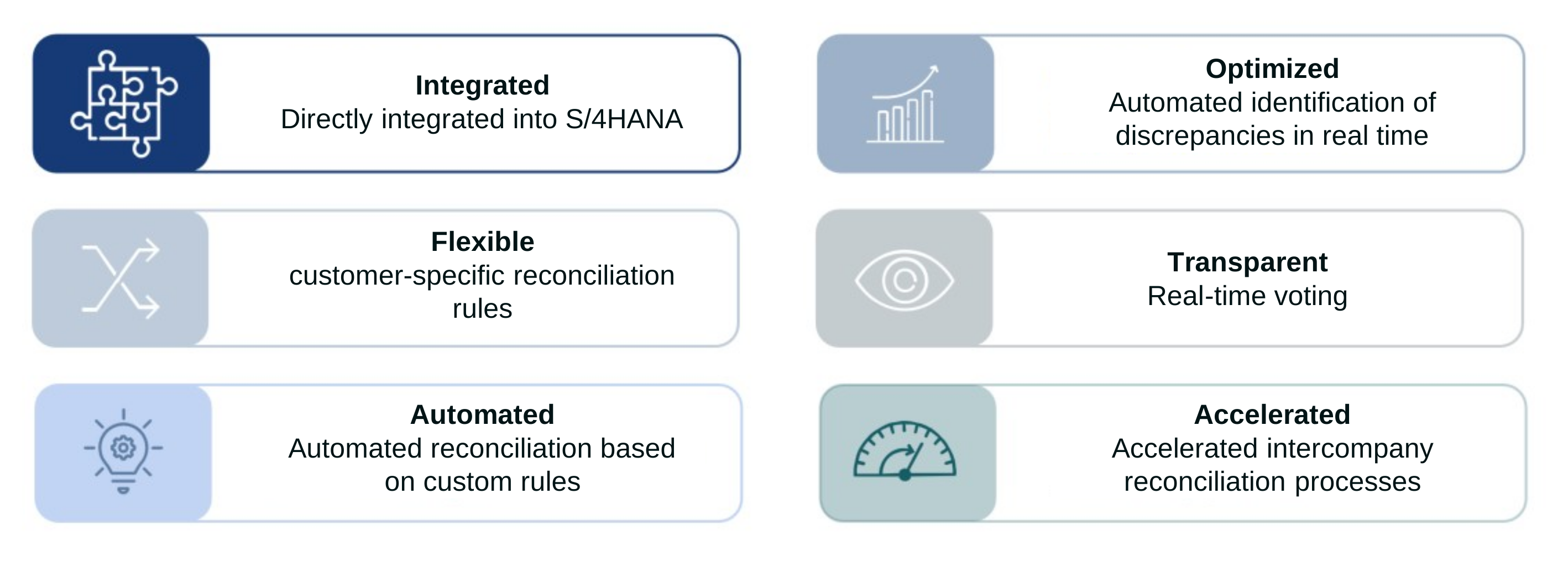
ICMR enables real-time intercompany reconciliation directly in S/4HANA. Postings can be processed automatically using flexible document validation rules. These document validation rules can be flexibly adapted to the company’s specific scenarios to identify the perfect IC pairs among the documents as well as to detect discrepancies and erroneous documents. This not only makes the accountant’s job easier, but also enables faster monthly and annual closings, bringing you one step closer to the famous “fast close.”
The benefits at a glance

Automated real-time document and balance reconciliation

Workflows for Resolving Discrepancies

Rule-based matching process

Automatic adjusting entries
Use Case Example
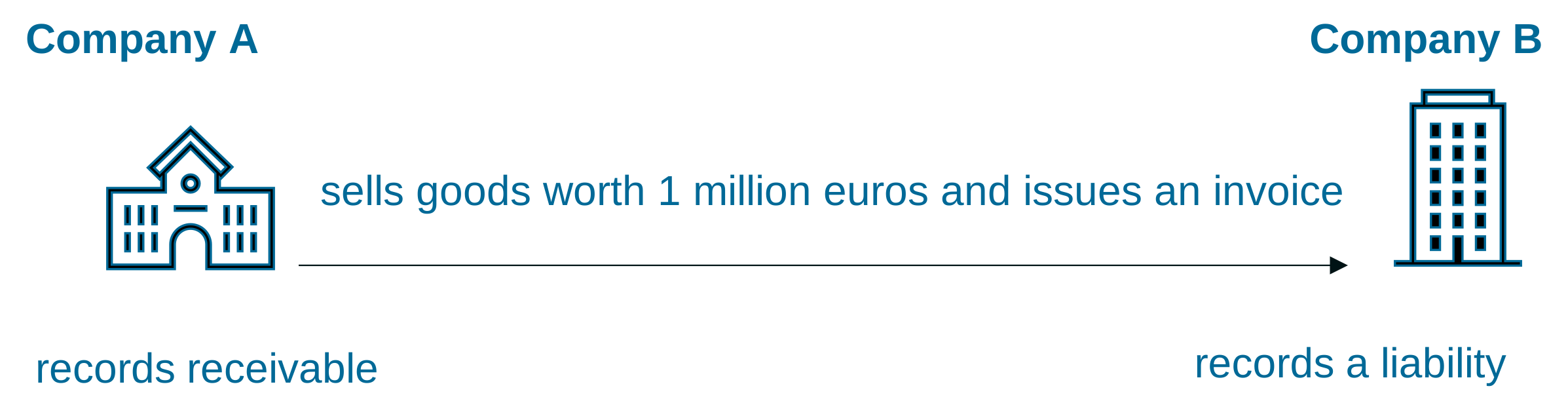
- Company A sells goods to Company B; the invoice amounts to 1 million euros.
- Company A records the receivable, and Company B records the liability.
| Without ICMR | With ICMR in the general ledger |
| Intercompany entries can only be reconciled at the end of the month | Automatic reconciliation is possible immediately after posting |
| Discrepancies become apparent late in the process and must be resolved under time pressure | Reconciliation runs can be scheduled on a regular basis |
| Significant communication efforts required when differences arise | Deviations are immediately visible |
| Resolution under tight deadlines by the end of the month | Stress-free settlement at the end of the month |
The result? Greater efficiency, fewer errors, and faster transactions.

ICMR automates intercompany reconciliations, making them transparent in real time and significantly more efficient—thereby reducing manual effort, enabling early detection of errors, and noticeably speeding up the closing process.
Comparison: Public Cloud vs. On-Premise
| Area | Public Cloud | On-Premise/Private Cloud |
| Updates | Automatically, quarterly | Manually, depending on the project |
| Flexibility | Focus on Best Practices | Highly adaptable |
| Implementation | Fast & standardized | More comprehensive, project-oriented |
| Innovation cycle | Available immediately | delayed |
Limitations and Challenges of ICMR
Despite its extensive features, there are certain factors that must be taken into account:
- Limited customization capabilities in the public cloud
- Reliance on clean master data and properly implemented posting logic
Overview of the Benefits of the SAP Solution
Summary
With ICMR, SAP offers a powerful solution for intercompany reconciliation that automates the entire process, increases transparency, and accelerates the closing process. Especially in the public cloud, companies benefit from rapid implementation, minimal administrative effort, and continuous innovation.
If you want to modernize your intercompany processes, ICMR is the way to go—especially with a clear focus on standardized finance processes.


