


Since 1920, Feintechnik GmbH in Eisfeld has been synonymous with world-class shaving products. What began over a century ago as a hub of high-quality craftsmanship has evolved into a state-of-the-art cornerstone of the global grooming industry. A decisive turning point came in 2014, when the New York-based startup Harry’s acquired the company. This combination of “old economy” and modern innovative spirit remains unique to this day: Eisfeld is now the world’s sole production site for Harry’s razor blades and systems.
Tradition Meets Innovation: Feintechnik GmbH Eisfeld on the Path to Success

As part of the global Mammoth Brands organization, Feintechnik GmbH Eisfeld, with approximately 430 employees working in three shifts, manufactures products for international markets, particularly North America. To meet the growing planning demands and the complexity of multi-stage manufacturing, the long-established company decided to work with CONSILIO to future-proof its production planning and comprehensively automate it using the SAP PP Optimizer.
Planning is the key to efficiency
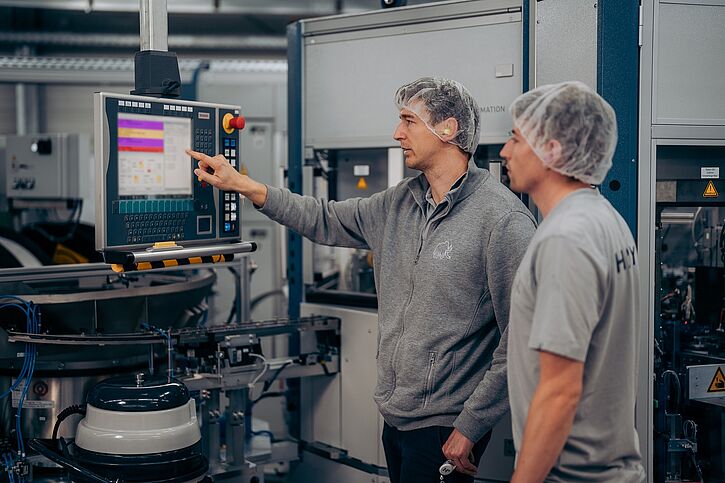
Harry’s Feintechnik already successfully uses SAP PP/DS in its day-to-day operations. The detailed planning board and product view form the basis for operational planning and ensure transparency in production.
Nevertheless, the process left much to be desired in terms of efficiency. The reason: Selecting supply sources and allocating capacity required a significant amount of manual effort. This tied up valuable planning resources and consequently had a negative impact on efficiency. There was a lack of true end-to-end automation across multiple production stages.
From a management perspective, there was therefore a lack of a strategic planning tool that
- autonomously determines optimal sourcing options and lot sizes based on rules,
- automatically generates planned orders and performs detailed scheduling,
- resolves scheduling and capacity conflicts, and simultaneously ensures stable inventory levels over the entire planning horizon.
The goal of company management was therefore to significantly reduce manual intervention while simultaneously ensuring higher planning quality, increased supply reliability, and significant improvements in profitability through lower safety stock levels and optimized resource utilization.

With the implementation of the SAP PP Optimizer, Harry’s Feintechnik has taken a major step toward intelligent, automated production control in its manufacturing operations.
Game-changer: SAP PP Optimizer

Since SAP PP/DS was already up and running smoothly at Harry’s Feintechnik, the existing detailed planning system needed to be systematically enhanced to significantly increase the level of automation—thereby improving planning quality, reproducibility, and business accuracy.
Essentially, those responsible aimed to establish a multi-level, rule-based planning system capable of managing both short-term detailed planning and long-term stable inventory trends. Planners were to be relieved of time-consuming routine tasks—particularly regarding supplier selection and lot sizing—so that they could focus on exception handling, evaluation, and targeted control. At the same time, the new logic needed to be robust and scalable to maintain consistent performance even as volume and complexity increased.
In consultation with their implementation partner CONSILIO, the Eisfelders identified the SAP PP Optimizer as the key solution to their challenge. Its strengths include automatic order generation in economically optimal lot sizes, cost-driven sourcing decisions, and true multi-level finite-bucket planning across the entire planning horizon.
Because the standard cost generation in the PP Optimizer could not reflect the operational complexity, a customized cost model was manually developed in collaboration with the business unit—including targeted penalty costs for excess inventory, falling below safety stock levels, delays, and incorrect deliveries, as well as variable production costs. This model was iteratively calibrated until the optimization results were convincing from both a technical and economic standpoint.
Planning now proceeds in two stages: First, the PP optimizer with a long horizon handles cost-optimized rough planning, including automatic order generation. Subsequently, the PP/DS optimizer with a significantly shorter horizon takes over time-continuous, finite detailed planning and smoothing.

Thanks to the professional support provided by CONSILIO, we were able to configure all the parameters, costs, and restrictions in the PP Optimizer in such a way that we could automate a large part of our planning processes.
Improved Planning Quality & Resilience Through SAP PP/DS Optimization
The result is a significantly more automated, transparent, and future-proof planning process within the existing SAP landscape. This has led to a substantial reduction in manual intervention, while the quality of planning has noticeably improved. In addition, inventory levels now remain within a defined, economically optimal range over the long term—and the company gains supply security while simultaneously improving resource utilization and reducing safety stock.
Fazit
With the implementation of the SAP PP Optimizer in combination with the PP/DS Optimizer, Harry’s Feintechnik has taken a decisive strategic step toward fully automated and integrated production planning. The two-stage solution combines long-term, cost-based bucket-finite rough planning with downstream time-continuous detailed planning—thus creating a true end-to-end planning chain across all manufacturing stages. This not only significantly reduces manual intervention but also substantially improves planning quality and reproducibility, while keeping inventory levels stable and economically optimal in the long term. As a result, the company gains a noticeable increase in supply security, cost efficiency, and resilience—a clear competitive advantage in an increasingly volatile production environment.
