


Demand Driven MRP (SAP DDMRP)
Here's how to efficiently plan and manage the value chain—based on customer needs.
Plan and manage your value chain efficiently - based on customer demand.
The operational planning and execution of production remains a constant challenge for many companies across various industries. The main reasons are usually market volatility and external factors that are often difficult to predict.
Most companies have traditionally used classic material requirements planning (MRP). MRP is a “push” method, where companies work with inventory levels based on forecasts. In contrast, DDMRP focuses on a “pull” approach, where materials for a product are retrieved and managed in a calculated buffer quantity. The goal is to realistically map and shorten material lead times in the short term.
These Are the Challenges Companies Face
- I have too little stock of the products I need.
- I have too much stock of the products I don’t need.
- I have too much in stock overall.
- I am unable to fulfill customer orders (on time and in the required quantity).
SAP DDMRP: How the planning tool is structured
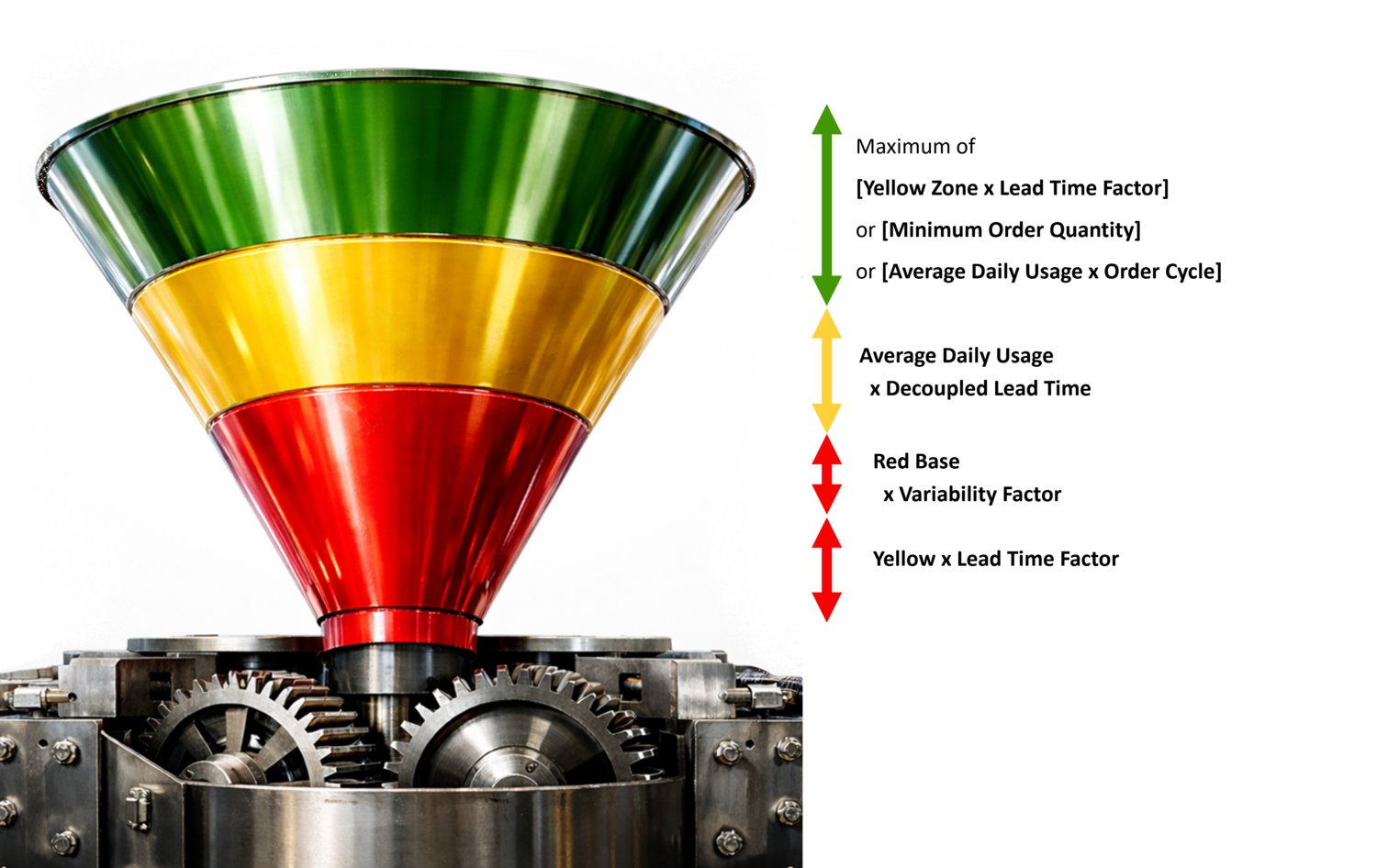
Buffers are the core component of DDMRP. They are divided into three zones:
- The green zone represents the lowest urgency in the inventory buffer. If the available inventory is within this zone, there should be sufficient inventory to meet current demand.
- The Yellow Zone indicates a medium level of urgency. Inventory levels have dropped below their ideal target, and replenishment is necessary.
- The red zone signals the highest level of urgency. Here, stock levels are at their lowest and have the highest priority for replenishment.
Five Functionalities of DDMRP
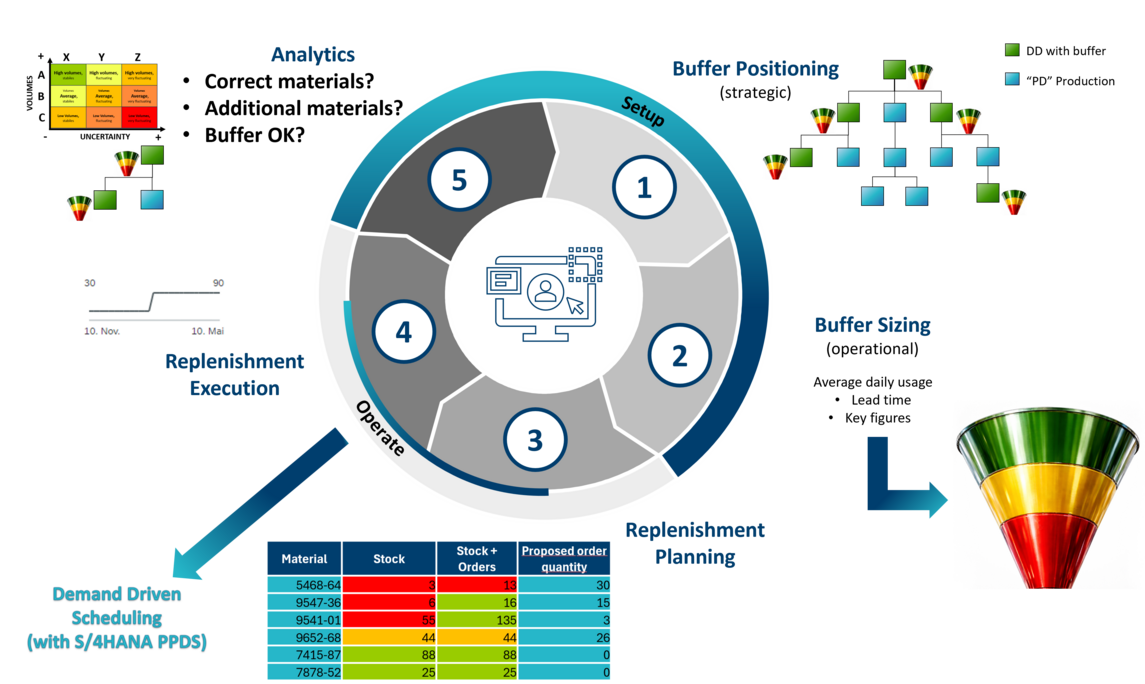
- Support for identifying DDMRP materials using key figures for a self-defined period:
- ABC – based on consumption values. The ABC key figures are self-defined.
- XYZ – weighting of individual materials based on their consumption variability. The XYZ key figures are self-defined.
- PQR – Analysis of Material BOMs. Here, the number of BOM usages is considered. PQR key figures are self-defined.
- EFG – Replenishment time analysis between two buffers. EFG key figures are self-defined.
- Option to intervene manually and override the results (in both directions)
- Support in determining the buffer size.
- Mass maintenance app for correcting/adjusting the buffer size (e.g. to a small load carrier size)
- Tabular and visual display of stock and buffer history.
- Alert monitor for critical materials (when the red zone is reached)
- Alert monitor for projected stock levels when stock falls below the safety stock level
- Full integration into PP/DS for planned orders and production orders is available, provided that the required PP/DS licenses are in place
- Dedicated PP/DS-DDMRP heuristic: SAP_DD_SCHED
- Historical buffer analysis (available from release 2023)
- Analysis of the buffer, e.g. number of days in the red zone for a material
- Display of outliers
- Stock levels
Consumption-Based Planning vs. DDMRP
Both planning techniques are distantly related, but the two methods differ in terms of the calculation formulas used. Example: Does a buffer need to be replenished, and if so, by how much?
| Consumption-Based Planning | DDMRP |
|
|
|
|

DDMRP enables rapid responsiveness to unexpected demand and factors such as bottlenecks.
Your benefits
- Efficient planning and management of supply chains based on customer demand
- Efficiency and optimisation in production and procurement planning
- Strategic decoupling of material flows
- Supply chain becomes less susceptible to the bullwhip effect and more resilient
- Production is safeguarded by dynamically managed buffers
- Better and faster adjustments at the planning and execution levels
- More accurate overview of actual material requirements
- Visual representation of key figures and buffers for the planner
![[Translate to English:] System-Beispiel: Visuelle Darstellung der Kennzahlen und Puffer für den Disponenten](/fileadmin/_processed_/2/b/csm_Puffer_verwalten_1ab538bc9e.jpg)