


Many companies face a major challenge when migrating to SAP S/4HANA: how to deal with their existing custom code. Custom ABAP programs, enhancements, and modifications that have evolved over many years must be checked for compatibility and stability in the new system and, if necessary, adapted. A well-founded custom code conversion is therefore indispensable.
However, beyond the technical necessity, custom code conversion also offers the opportunity for modernization, optimization, and the use of new SAP technologies. A successful custom code conversion is thus a key success factor for any S/4HANA transformation.
In this blog post, you will learn:
- Why custom code conversion is necessary
- Which tools support the process
- How to proceed strategically and methodically

Why Custom Code Conversion?
The term custom code conversion refers to the analysis, cleanup, and adaptation of customer-specific developments such as ABAP programs, user exits, modifications, and more, in order to make them compatible with SAP S/4HANA and future-proof.
By cleaning up and converting custom code, typical challenges such as increased migration costs, technical incompatibilities, and long-term system instability can be avoided.
A central principle in this context is the Clean Core principle: the SAP standard (system core) should remain as untouched as possible. Extensions should be decoupled using recommended technologies and frameworks such as SAP Business Technology Platform (BTP), ABAP RESTful Application Programming Model (RAP), key user extensions (in-app), and side-by-side extensions. This reduces long-term costs and minimizes effort for future upgrades.
The Custom Code Conversion Process
The following overview shows the typical phases of a custom code conversion – from preparation to implementation:

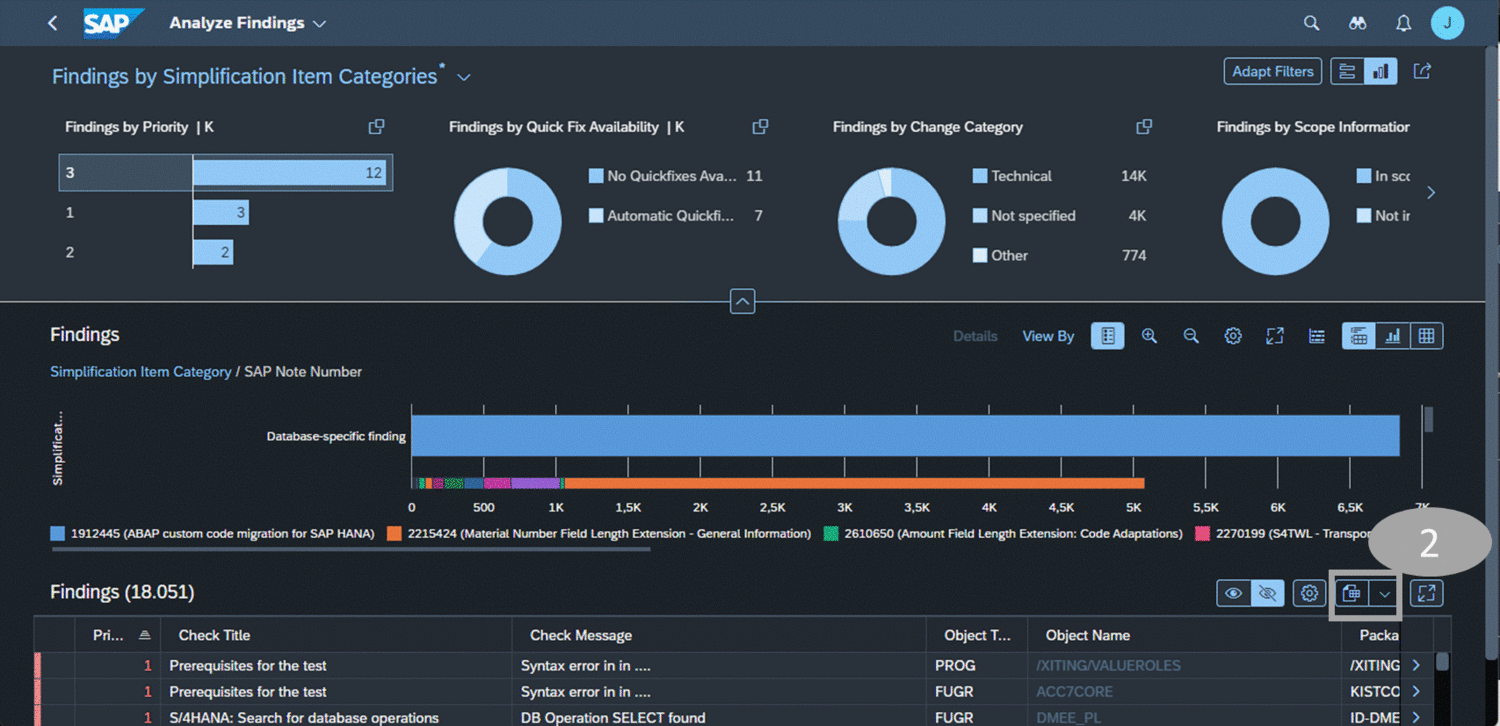
Creating analysis and transparency
The goal is to analyze the inventory, usage, and compatibility of custom developments.
Tools used include SAP Readiness Check, SAP Custom Code Migration App (Fiori app), Simplification Item Check (SI Check), ABAP Test Cockpit (ATC), SCMON (ABAP Call Monitor) / UPL (Usage and Procedure Logging), and the Custom Code Migration Worklist.
These tools help answer key questions:
- Which developments exist?
- Which ones are actually used?
- Which ones are not compatible with SAP S/4HANA?
Evaluation and Decision-Making
In this phase, the analyzed code is evaluated, classified, and prioritized:
- Reusable (possibly with adaptations)
- Obsolete (to be decommissioned or deleted)
- Not compatible (redesign required)
Criteria such as frequency of use, criticality, and business relevance are taken into account. The result is a custom code inventory with a strategic plan per object type (e.g., reports, forms, enhancements).
Particularly important: reducing “dead” developments lowers migration effort and improves transparency.
Those who consistently analyze, clean up, and modernize their legacy systems now will lay the foundation for:
- Faster migration to new SAP environments such as S/4HANA
- Reduced costs through lower maintenance requirements and greater efficiency
- Increased system stability through a clean and high-performance code base
- Future-proofing to enable flexible integration of new technologies and business models
A modern SAP system starts with modern code – take the opportunity to make your system fit for tomorrow's requirements.
Your Next Step Toward a Successful S/4HANA Transformation
Are you currently planning your migration to SAP S/4HANA or facing the challenge of analyzing your Z code and making it future-ready?
Get in touch with us now – we will support you on your journey toward a future-proof system landscape.

Custom code conversion is more than just a requirement for S/4HANA—it is the key to a clean core, lower operating costs, and true innovation.


