


A contract manufacturing process does not necessarily end with the first external partner. If a second contract manufacturer takes over the next production stage directly, a multi-stage process chain is created: The intermediate product moves from partner to partner, while planning must maintain an overview of deadlines, material requirements, and dependencies. This is precisely where a functional limitation of PP/DS has existed until now.
As industrial value chains become increasingly specialized, manufacturing networks are growing more complex. Multiple external partners may be involved in the production of a product or assembly, one after another.

A typical scenario: A contract manufacturer handles a production stage. However, the result is not initially returned to the client company but is forwarded directly to another external partner. This partner handles the next processing or manufacturing step and, if necessary, passes the intermediate product on to another contract manufacturer or to its own plant.
This creates a process chain in which multiple external processing and transportation stages must be coordinated with one another (see image on the right).
For production planning, it is crucial that requirements and receipts along this chain remain linked. This is precisely where embedded PP/DS reached its functional limits in previous SAP S/4HANA releases.
When PP/DS loses track of component requirements
In previous SAP S/4HANA releases, the target location of a generated purchase requisition was correctly derived from the master data of the planning area or the defined special procurement key. However, the associated component requirements were not fully passed on throughout the entire subcontracting chain.
This problem occurred in particular when the result of a subcontracting step was to be forwarded directly to a downstream subcontractor. If the target location of the purchase requisition referred to this next external partner, the requirements for the associated components at the underlying bill of materials level in PP/DS were lost.
The consequences were evident in the planning views: The component requirements were not displayed completely or transparently, neither in the product view (SAP APO/RRP3) nor in the pegging structure of PP/DS.
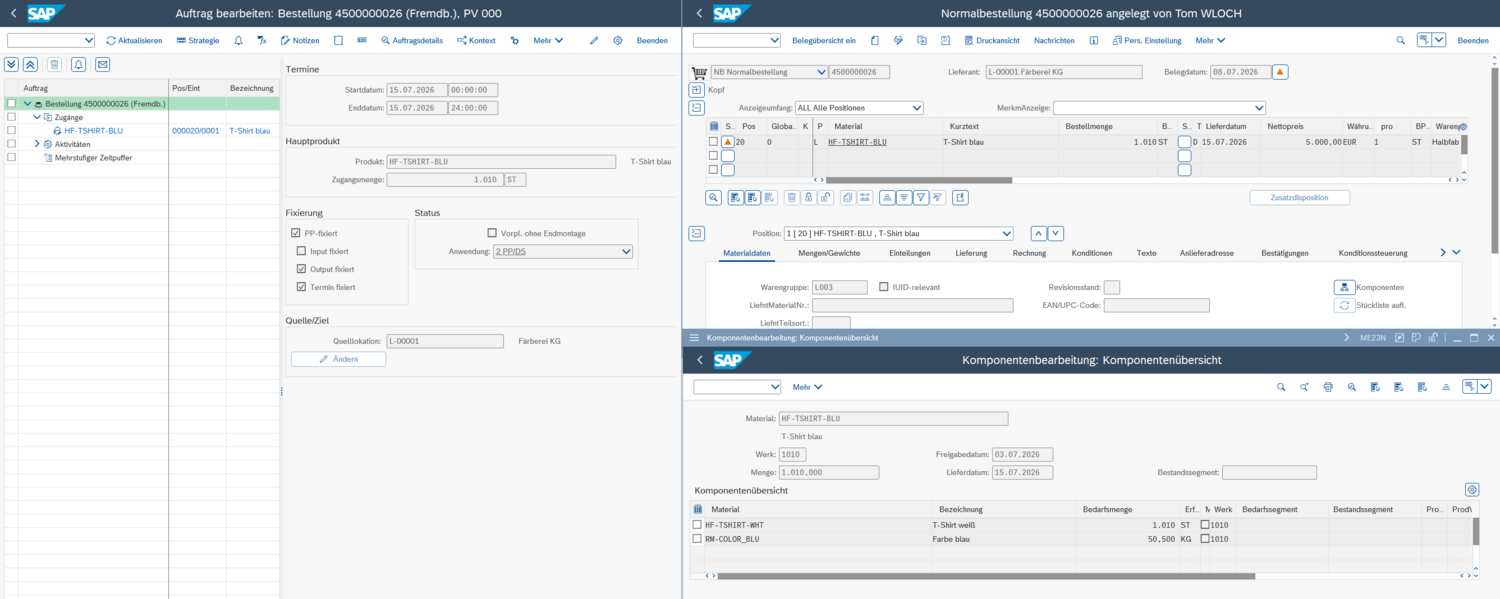
This limitation became particularly evident when comparing the operational procurement data in SAP S/4HANA with the planning view in PP/DS. In the “Display Purchase Requisition” application (ME53N), the relevant components were displayed correctly. In PP/DS, however, only the expected goods receipt from external processing was visible as a receipt. The components required for this did not appear either in the product view or within the requirements structure.
For the planner, this meant that while the physical process could be set up correctly from a business perspective, the planning view did not fully reflect the relationship between the receipt and the component requirements.

However, in PP/DS, it has not been possible to consistently account for demand and material flows across multiple external manufacturing stages. With SAP S/4HANA 2025, SAP is expanding embedded PP/DS to include standard support for this scenario.
Two detours that unnecessarily prolong the process
As long as the forwarding of demand across multiple external manufacturing stages did not function seamlessly, two approaches had become established in practice.
- Each partial delivery is first posted back to the company’s own plant before being forwarded to the next contract manufacturer. From there, the intermediate product is shipped again to the next external partner. This approach increases logistical effort, results in additional shipments, and in many cases does not make business sense. Above all, however, it does not reflect the actual desired material flow.
- Alternatively, the destination shipping address can be manually changed to the downstream subcontractor. While this allows the desired physical process to be reflected, However, in the previous PP/DS planning, this resulted in the described limitations regarding demand forwarding and traceability.
Both workarounds increase the manual coordination effort. In the worst-case scenario, this can lead to planning errors that may affect on-time delivery and capacity utilization.
Don't miss any more news
SAP S/4HANA 2025 Brings the Supply Chain into Planning
With SAP S/4HANA 2025 and SAP S/4HANA Cloud Private Edition 2025, which were released in the fourth quarter of 2025, SAP supports multi-stage subcontracting as a standard feature in embedded PP/DS for the first time.
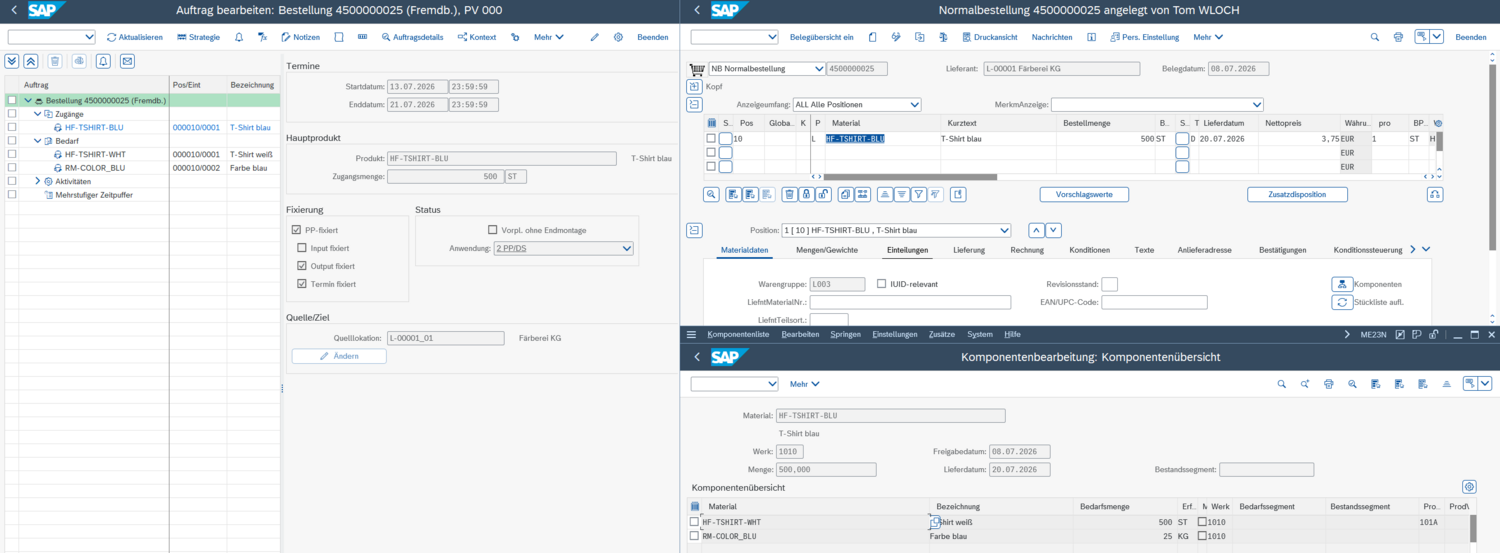
This enhancement addresses a gap that is particularly relevant in complex external manufacturing networks: multi-stage subcontracting processes are integrated into the PP/DS planning logic. Requirements can be passed on across multiple consecutive subcontracting stages and made visible in the planning views.
This provides production planners with a more consistent view of the entire chain. Component requirements, material provisions, and goods movements between multiple subcontractors can be taken into account in planning—even when an intermediate product is forwarded directly from one external partner to the next.
In addition to material requirements, PP/DS also takes into account the processing and transport stages within the contract manufacturing chain. The dependencies between the individual process steps become more transparent and can be incorporated into scheduling and detailed planning. This allows potential supply bottlenecks to be identified earlier.
Needs and access remain interconnected
Another important aspect is traceability within the pegging structure. Requirements and receipts remain linked across multiple levels. This enables planners to better identify which components are needed for a specific production order or customer requirement and where they are located in the subcontracting chain.
This connection is particularly crucial in multi-stage scenarios. A missing component requirement does not affect just a single order; it can impact downstream processing steps, deadlines, and the supply to the next partner. A consistent planning view therefore creates the conditions for identifying dependencies earlier and better coordinating the individual process steps with one another.
Conclusion: Plan multi-stage contract manufacturing from start to finish
Multi-stage contract manufacturing is part of everyday operations in many industries. Several external partners carry out defined manufacturing or processing steps in sequence before the finished product returns to the company’s own facility or moves on to the next process.
However, in PP/DS, demand and material flows across multiple external manufacturing stages could not previously be consistently accounted for. With SAP S/4HANA 2025, SAP is expanding embedded PP/DS to include standard support for this scenario.
Companies with a high proportion of external manufacturing steps should evaluate this feature as part of their upgrade and innovation planning. It is particularly relevant in situations where intermediate products are moved directly between multiple contract manufacturers and production planning still requires a consistent view of requirements, receipts, deadlines, and dependencies.
At the same time, this enhancement demonstrates that SAP is aligning production planning more closely with cross-organizational manufacturing and supply networks. This gives companies the ability to map complex contract manufacturing processes more consistently in production planning and to eliminate the need for procedural workarounds.