product cost
posting
Whilst in traditional ERP systems many calculations relating to product costs were only carried out at the end of the accounting period, the calculation of work in progress (WIP), overheads and variances now takes place immediately upon the occurrence of the relevant business transactions.
The result: greater transparency, reduced closing effort and a significantly more up-to-date view of actual production costs. 3F0 is now the recommended standard for product cost controlling in the S/4HANA Public Cloud and replaces the previous Scope Item BEI (Period-End Closing – Plant), which has been deprecated since Public Edition 2408.
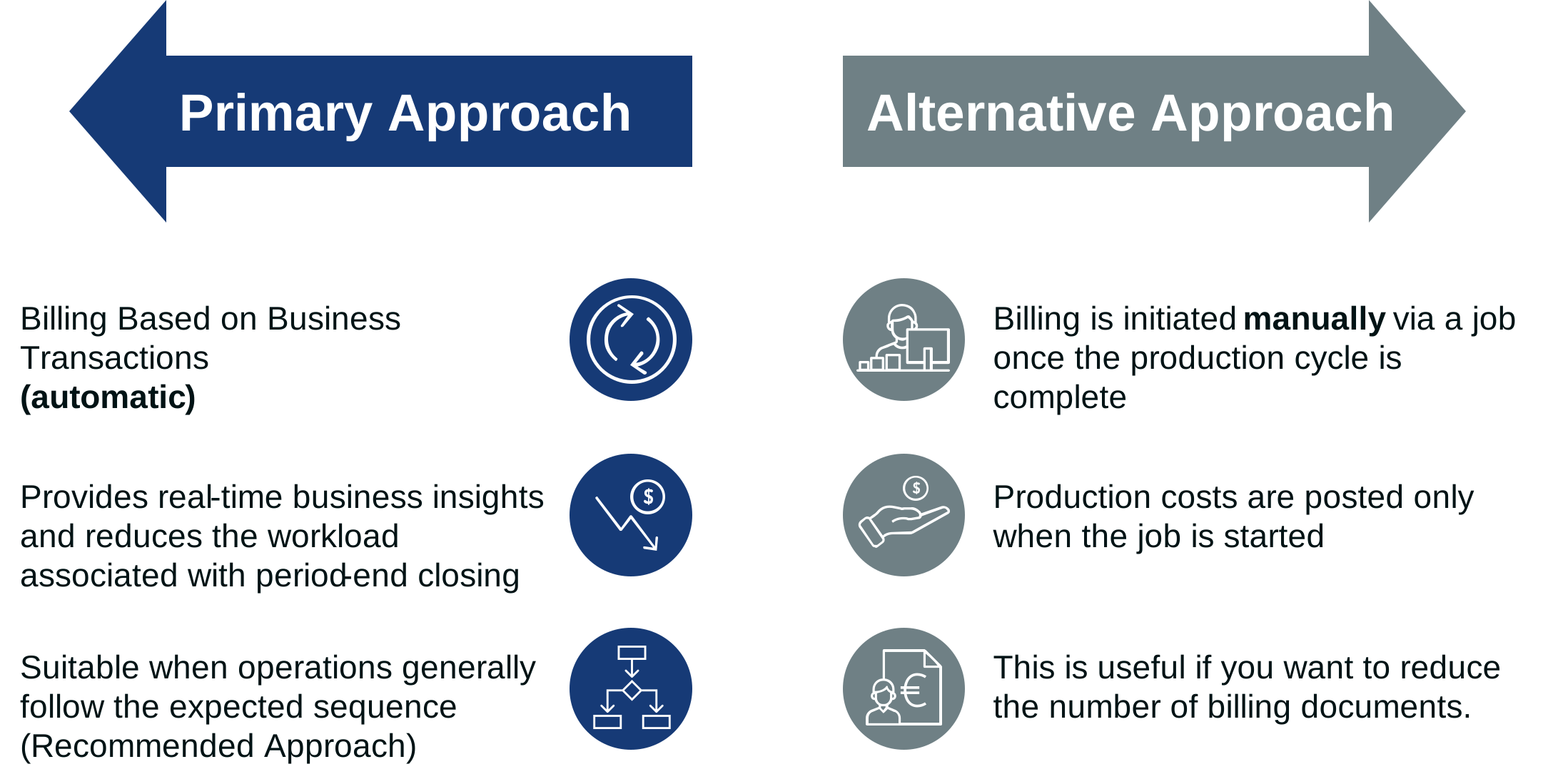
A key advantage of 3F0 is the flexibility it offers in triggering settlement. SAP supports two different approaches for this:
Never miss another update
Automatic transaction-based settlement (primary approach)
Under the recommended standard procedure, settlement is triggered automatically by business events such as goods movements or work confirmation. This ensures that production costs are posted immediately as they arise.
- This approach offers several advantages:
- Real-time transparency regarding WIP and variances
- Reduced workload for period-end closing
Up-to-date cost information throughout the entire production process
Automatic settlement is particularly suitable for companies whose production processes follow a stable and predictable sequence of operations. This means that once the status DLV (Delivered) or TECO (Technically Completed) has been reached, changes to production orders are rarely made.
Please note: In the long term, this approach generates a large number of settlement documents.
Manual transaction-based billing
Alternatively, the settlement can be initiated manually via a background job. In this case, the production costs are not posted until the job is executed.
This approach is particularly recommended if:
- you wish to avoid a very large number of settlement documents,
- retroactive withdrawals are predominantly used,
- production orders have only a short life cycle and no ongoing WIP calculation is required, or
- logistical business transactions frequently deviate from the expected sequence of operations.
What does ‘event-based’ mean?
In traditional periodic product cost controlling, many valuations were not carried out until the end of the month. These included, for example:
- Work-in-progress (WIP) calculation
- Overhead cost calculation
- Variance analysis
- Order settlement
With Scope Item 3F0, these processes are linked to operational events, such as:
- Material withdrawals (goods issue)
- Confirmation of production output
- Goods received from production
- Technical completion of production orders
As a result, product cost information is generated almost in real time and is immediately available for reporting and analysis.


Thanks to CONSILIO, we were able to establish a globally standardized controlling framework at our largest European locations and successfully harmonize our CO processes and master data.
Use with production orders and product cost collectors
The Scope Item 3F0 supports the settlement of both production orders and product cost collectors. The key difference lies, in particular, in the use of processing keys based on business events or manual settlement.
Two operation-related processing keys are provided in each case for the use of operation-related production cost postings for production orders and product cost collectors. The two processing keys, along with further similarities and differences, are set out in the table below.

Categories of deviation

Restrictions
The following scenarios are not supported by periodic product controlling in activity-based production accounting:
- Product cost collectors with mixed costing
- Product cost collectors with a valued sales order balance in the make-to-order scenario
- Product cost collectors with a valued project balance in the project manufacturing scenario
- Product cost collectors for product materials with separate valuation
- Product cost collectors with different settlement recipients for materials and non-materials
The key benefits of Scope Item 3F0
1. Real-time transparency
Production costs are no longer only visible at the end of the month. Companies can now identify the following whilst production is still underway:
- current production costs
- work in progress (WIP)
- variances that have arisen
- production performance
This enables problems to be identified much earlier and corrective action to be taken more quickly.
2. Significantly less work involved in closing the accounts
Many traditional month-end tasks are being eliminated or significantly reduced.
Instead of extensive month-end closing activities, valuations are carried out continuously during production. This significantly shortens the time taken to complete the month-end closing and reduces the amount of manual work involved.
3. Support for parallel financial reporting
A key advantage of 3F0 is that valuations can be carried out simultaneously for different ledgers and accounting standards.
This makes the solution ideally suited to companies with:
- IFRS
- Local GAAP
- Group valuation
- multiple currencies
Valuations are carried out consistently across all accounting levels.
4. Improved integration with the Material Ledger
Companies that also use actual costing (Scope Item 33Q) benefit from seamless integration.
Scope Items 3F0 and 33Q – actual costing – complement each other perfectly. Whilst 3F0 continuously calculates WIP, overheads and variances on the basis of individual business transactions, actual cost calculation processes this information further during the period-end closing and allocates the costs actually incurred to materials and stock.
This provides companies with both transparency regarding production costs during the financial year and a precise periodic calculation of actual production costs.
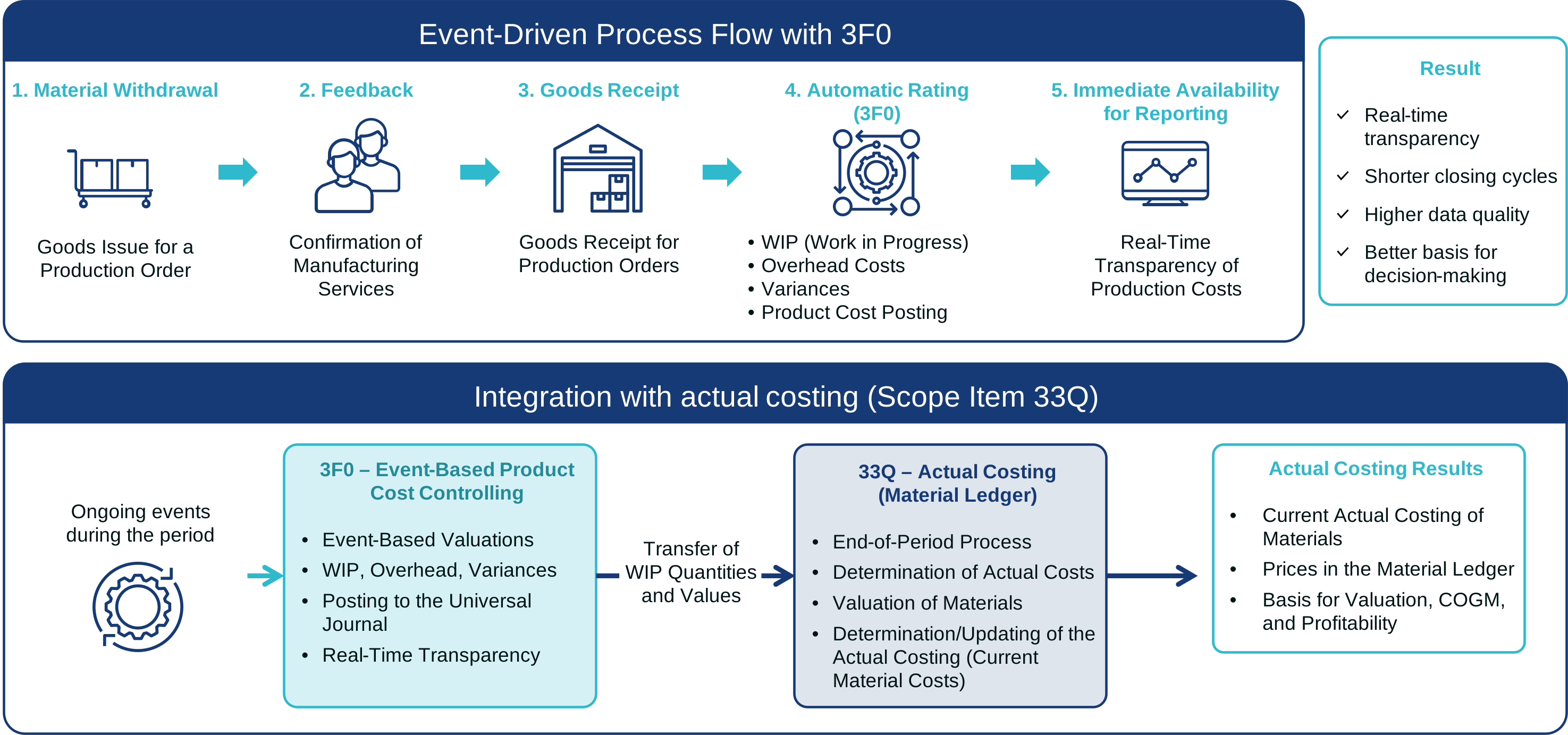

Once the transaction-related valuations have been completed, the values can be transferred directly to the material ledger actual cost estimate. For this process, the WIP quantities must be calculated before the actual cost estimate run is started.
How does the process work?
A typical production process looks as follows:
- Material is issued.
- Work activities are confirmed.
- Goods receipt is posted.
- The system automatically calculates:
- WIP
- Overheads
- Variances
5. The information is immediately available for reporting and management control purposes.
Only in exceptional cases do incorrect postings need to be corrected using the relevant post-processing jobs.
Who is Scope Item 3F0 suitable for?
The solution is particularly suitable for companies with:
- mass production
- discrete manufacturing
- process manufacturing
- short financial cycles
- high transparency requirements
- parallel accounting
Companies operating internationally, in particular, benefit from simultaneous valuation across multiple ledgers and currencies.
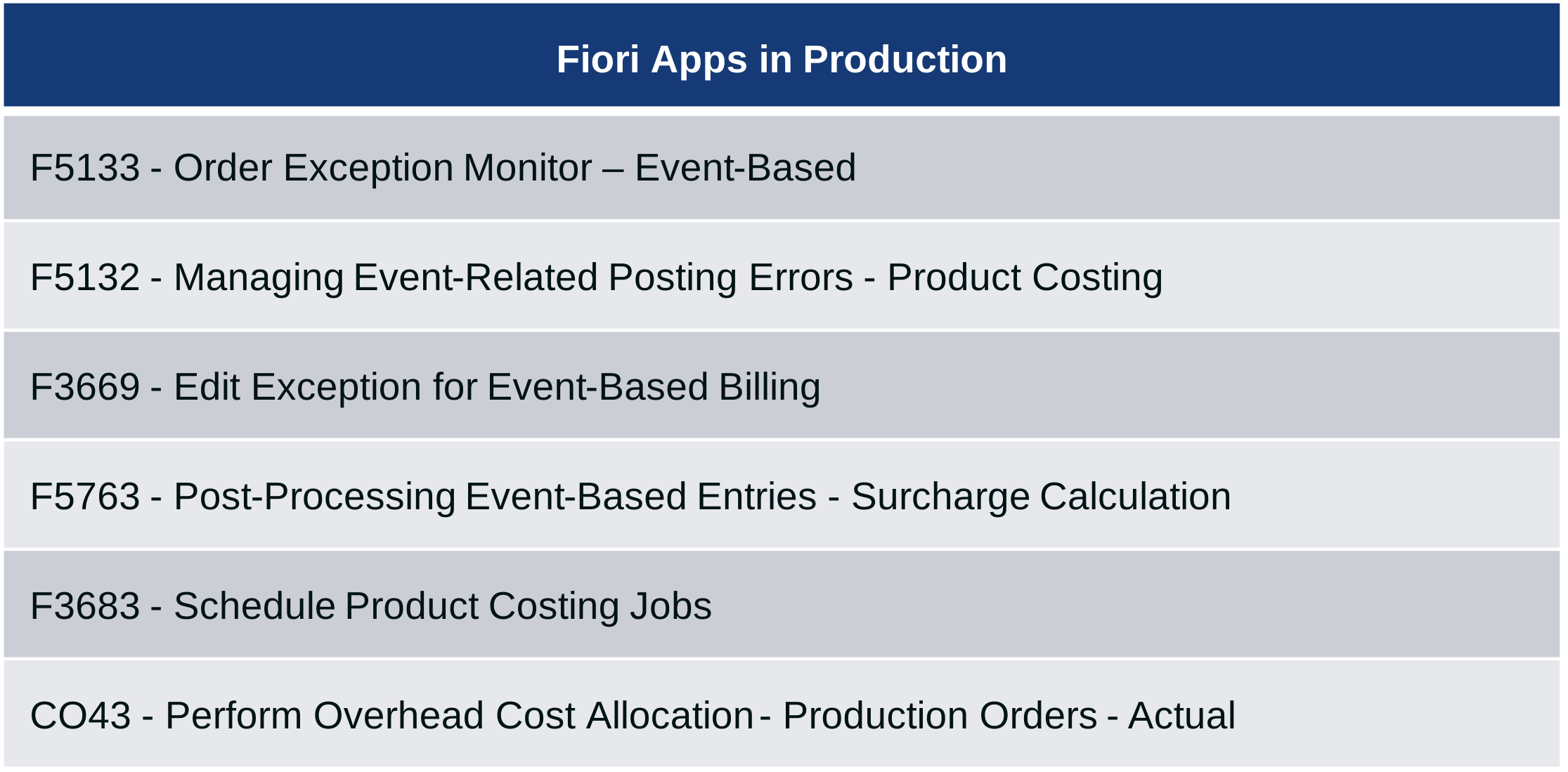
Relevant Fiori apps

Summary
With Scope Item 3F0, SAP is modernising product cost controlling in the SAP S/4HANA Public Cloud. The shift from periodic to event-driven valuations reduces the workload involved in monthly closing, increases transparency during production and improves the data basis for operational decisions.
Particularly when combined with actual costing (Scope Item 33Q), 3F0 offers an end-to-end solution for modern, integrated product cost controlling – from the first production posting through to the calculation of actual production costs at the end of the period.