In recent years, artificial intelligence has evolved from an experimental technology into an integral part of modern enterprise software. Generative AI assistants such as ChatGPT, Gemini, Claude, and Microsoft Copilot now help users search for information, create content, and automate repetitive tasks. What began with general-purpose AI assistants is now also taking hold among major enterprise software providers. The focus is increasingly shifting from answering individual questions to specialized AI assistants and AI agents that support users in specific tasks and facilitate business processes across system boundaries.
SAP is also following this trend with its generative AI assistant, Joule. As part of its Autonomous Enterprise vision, SAP is continuing to develop its AI architecture. The Autonomous Suite is intended to create an execution layer in which specialized AI assistants orchestrate various AI agents, thereby supporting end-to-end business processes across system and application boundaries. Joule serves as the central interface between users and this new AI architecture.

The architecture spans numerous business areas. SAP has announced specialized AI assistants for Finance, Procurement, Human Resources, Customer Experience, Supply Chain, and Manufacturing. Each supports specific business roles and coordinates the AI agents required for a given business process.
The following article first explains Joule’s role within SAP’s AI strategy, as well as the interaction between AI assistants and AI agents. It then presents the announced innovations for manufacturing and supply chain management. The focus is on how Joule is evolving from an AI copilot into a platform for role-based AI assistants and specialized AI agents. For manufacturing and supply chain management, this transformation means, above all, that operational analyses, exceptions, and follow-up processes can be coordinated more effectively across processes in the future.
Never miss another update
Joule as an Entry Point for SAP Business AI
Joule is SAP’s central AI solution and the entry point for AI-powered interactions within the SAP Business Suite. For users, Joule primarily serves as an AI copilot through which they can retrieve information or initiate tasks using natural language. At the same time, Joule acts as the interface to specialized AI assistants and, with features such as Joule Studio and the Agent Builder, is increasingly evolving into a platform for company-specific AI applications.
In day-to-day work, users primarily interact with Joule via a chat or dialogue interface. Instead of searching for information across various applications and menus, they can ask questions in natural language or initiate tasks directly from within the relevant business process. Joule takes the business context into account, accesses company data, and provides relevant information or assists in executing processes.

Unlike general AI assistants, Joule is directly integrated into the SAP application landscape. This allows the AI copilot to access business processes and company data from solutions such as SAP S/4HANA, SAP Digital Manufacturing, SAP EWM, or SAP IBP. If other enterprise applications are connected, information from third-party systems can also be incorporated. The responses are thus based not only on the content of a single application but also on the specific process context.
Another difference from freely available AI solutions is that Joule was developed for use in enterprise environments. Role-specific permissions, data protection, and compliance requirements are integral parts of the solution. In addition, Joule has a pre-trained understanding of SAP business processes and can therefore classify information according to business context and provide it within that context.

The evolution from Joule to the SAP Autonomous Suite and on to customer-specific extensions using Joule Studio is transforming access to SAP processes. In the future, users will perform fewer individual transactions and focus more on business objectives, exceptions, and results.
AI Copilot, AI Agent, and AI Assistant: The Differences
With the new features announced at SAP Sapphire 2026, SAP is significantly expanding Joule’s functionality. In the future, the AI Copilot will serve as the central entry point for specialized AI assistants. These, in turn, coordinate various AI agents to handle complex tasks across multiple business processes. At the same time, SAP is opening up the platform with Joule Studio and the Agent Builder to enable the development of custom AI agents and company-specific AI applications.
The AI Copilot: Answers and Actions at Your Command
The AI copilot serves as the interface between the user and artificial intelligence. It typically appears as a chat or dialogue interface within an application and enables users to retrieve information or trigger actions. Instead of navigating through menus or performing transactions manually, the user describes their request in their own words. The copilot interprets the input, accesses a large language model (LLM) and other AI services, and links these to corporate data and the functions of the respective business application.
In the SAP environment, Joule fulfills this role. The solution serves as the user interface between the user and the AI assistants and AI agents working in the background. Since Joule is directly integrated into SAP applications, users can query information using natural language or initiate tasks directly from within their workflow.
The key difference from an AI agent lies in how they operate: A copilot responds to the user’s instructions and provides information, recommendations, or results. The user typically decides how to use this information. An AI agent, on the other hand, independently pursues a defined goal, plans the necessary steps, and can carry out tasks within a business process on its own. The copilot thus serves as the interface between humans and AI, while agents operate autonomously in the background.
The AI Agent: Autonomous Task Execution Within the Process
When people talk about AI agents today, they mean more than just a chatbot that answers questions or generates text. An AI agent is a software-based component that connects an AI model with process knowledge, data access, and defined actions. This enables it to independently analyze, plan, and process tasks within a specific business process.
An AI agent is given a goal and decides how to achieve it. To do so, it analyzes the initial situation, accesses available data and applications, evaluates interim results, and adapts its approach to changing conditions. The individual steps do not need to be fully specified in advance.

However, the degree of autonomy can vary. Simple agents respond to predefined events or rules. Others incorporate additional information, take previous results into account, or plan multiple steps in advance. More powerful agents pursue an overarching goal and coordinate various subtasks to achieve it as efficiently as possible. Depending on the application, different types of agents are therefore used.
In the SAP environment, access to the correct business context is crucial. With the help of the SAP Knowledge Graph and the SAP Business Data Cloud, AI agents can establish connections between data and business processes, thereby interacting more reliably with business applications. They do not operate in isolation from a company’s workflows but take master data, transaction data, and process logic into account.
This opens up new possibilities, particularly in manufacturing, where planning, production, and quality assurance are closely intertwined. An agent can consolidate information from various systems, detect anomalies, or trigger downstream processes. Subject-matter responsibility remains with humans, while recurring tasks and routine processes can increasingly be automated.
The AI Assistant: Coordination Based on a Specific Role
With the new AI assistants, SAP is expanding the existing Joule concept to include an additional layer. While a single AI agent handles a clearly defined task or a specific process step, AI assistants guide users through more comprehensive business processes. They have role-based context and coordinate multiple specialized AI agents in the background.
The focus is thus less on individual actions and more on managing an entire workflow. Depending on the user’s role and the situation, AI assistants can aggregate relevant information, determine the next logical step, engage appropriate agents, and consolidate their results. For the user, this creates a central point of contact that guides them through the respective business process, rather than simply answering individual queries.
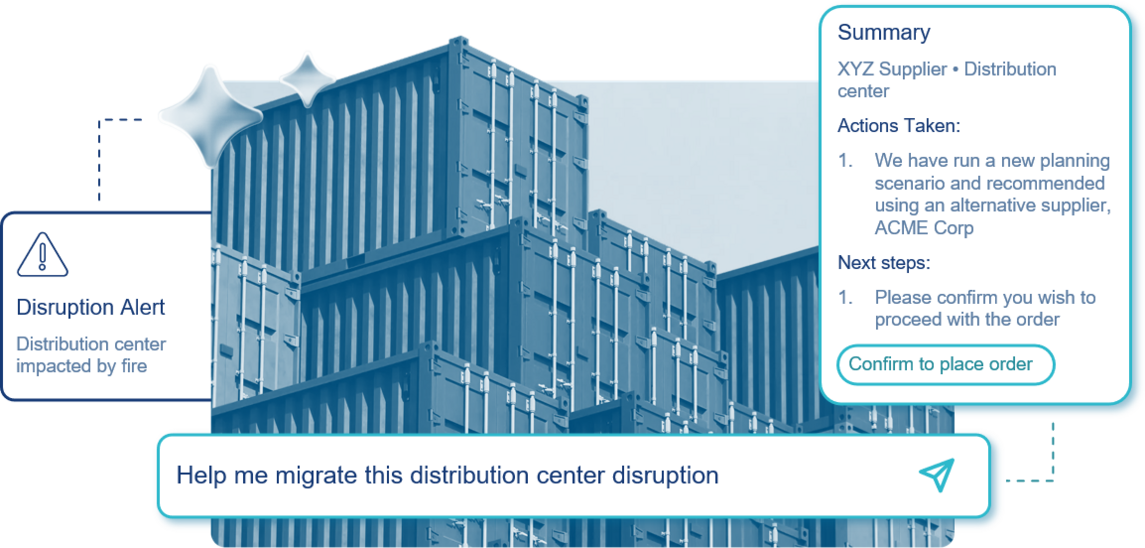
SAP plans to gradually roll out role-based AI assistants for key business areas such as finance, procurement, human resources, and supply chain management. These assistants are based on the specific context of each role, as well as company data and business processes. The goal is to enable employees to make informed decisions more quickly and manage complex processes with the support of multiple specialized AI agents.
Joule, Assistant and Agent: The Example of a Production Variance
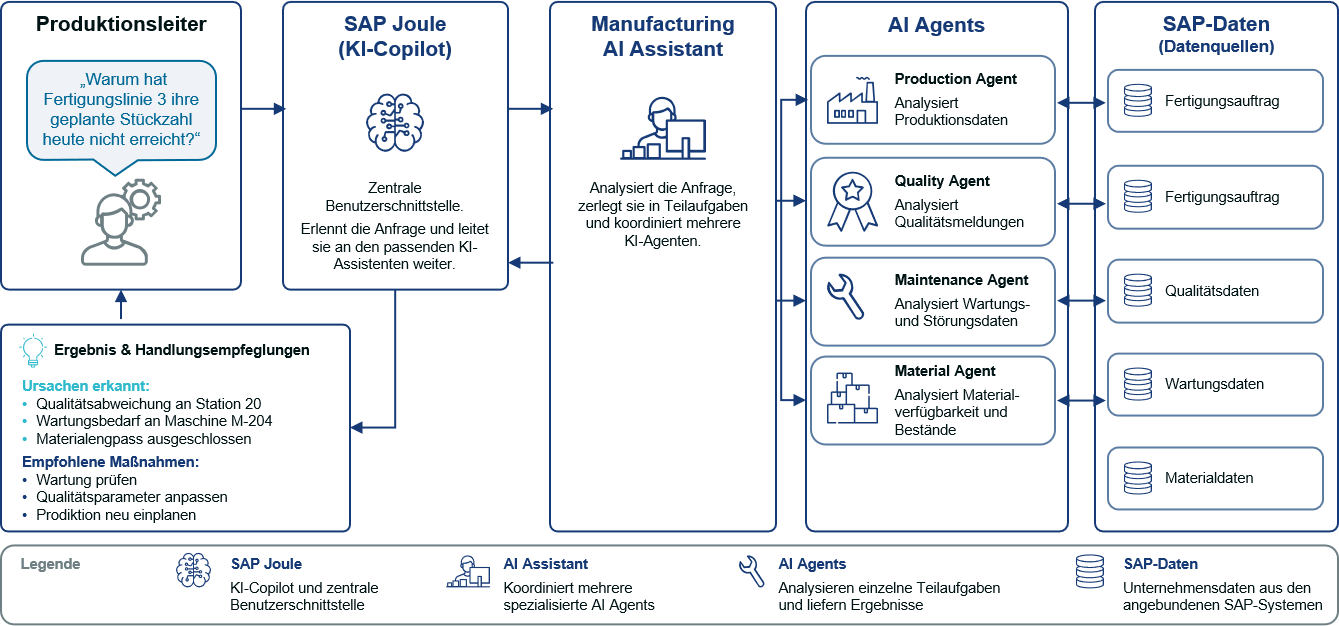
A real-world example illustrates how these three levels work together: A production manager wants to know why a production line failed to meet its planned output. He asks Joule directly.
The AI copilot recognizes that the Manufacturing Assistant is responsible and forwards the request. The Manufacturing Assistant breaks the question down into subtasks and assigns them to the appropriate AI agents. These agents analyze, for example, production data, quality reports, or maintenance information and report their findings back to the assistant.
The Manufacturing Assistant consolidates the information and prepares it for the user. Joule then presents a clear answer that includes the identified causes and possible recommendations for action. This illustrates how the levels work together: Joule serves as the central interface to the user, the AI Assistant coordinates the process, and the AI agents handle the analysis of the individual tasks.
Now that this interplay has been explained, its potential benefits are particularly evident in supply chain management. This is where planning, manufacturing, logistics, and partner networks intersect directly. The coordination of specialized assistants and agents can therefore be especially relevant when dealing with cross-functional exceptions.
AI Support Throughout the Entire Supply Chain
With Autonomous Supply Chain Management, SAP aims to further automate the supply chain and support decision-making right where decisions are made. The focus is not on individual AI functions, but on the interaction between specialized Joule Assistants, AI agents, and existing business processes.
Employees remain responsible for strategic decisions, while AI assistants coordinate time-sensitive analyses, recurring tasks, and complex workflows. This is intended to enable earlier detection of disruptions, accelerate decision-making, and better coordinate workflows across application boundaries.
The potential added value stems primarily from the combination of process knowledge, real-time data, and automated coordination. The assistants do not replace subject-matter expertise. However, they can reduce the need for manual coordination and accelerate decision-making in situations where multiple departments are affected simultaneously.
Joule Assistants for the Supply Chain
SAP provides specialized Joule Assistants for various areas of the supply chain, each tailored to a specific business domain:
- Product Design Assistant: supports development and engineering teams with product changes, compliance requirements, and cross-functional collaboration.
- Planning Assistant: analyzes demand, inventory, and planning exceptions; identifies potential bottlenecks; and assists with sales and production planning.
- Manufacturing Assistant: Coordinates AI agents within manufacturing, links shop floor data to the operational business context, and supports production managers in root cause analysis and decision-making.
- Asset and Service Assistant: Identifies maintenance needs, prioritizes maintenance tasks, and coordinates service and maintenance processes across equipment and locations.
- Logistics Assistant: supports warehousing and transportation processes, coordinates logistics operations, and helps maintain material flows even in the face of last-minute changes.
- Business Network Assistant: improves collaboration with suppliers, logistics service providers, and other business partners to manage processes across organizational boundaries.
The Role of People in the Autonomous Supply Chain
With Joule Assistants, SAP is pursuing the vision of an increasingly autonomous supply chain. This does not eliminate the role of humans; rather, it transforms it. Goals and priorities continue to be set by the business units. The AI assistants coordinate cross-functional processes, while specialized AI agents handle individual tasks within defined business processes.
Technical responsibility thus remains with humans. Employees must be able to interpret results, evaluate decisions, and intervene in critical situations. The potential benefit lies less in completely replacing human decisions and more in reducing manual coordination and repetitive analyses. This frees up more time for tasks that require experience, judgment, and strategic thinking.
Note: SAP plans to make the Manufacturing Assistant generally available in the second quarter of 2026. The Asset and Service Assistant and the Logistics Assistant are scheduled to follow in the third quarter of 2026. SAP has set the fourth quarter of 2026 as the release date for the Product Design Assistant, the Planning Assistant, and the Business Network Assistant.
Outlook: Where Is SAP Business AI Headed?
The innovations unveiled at SAP Sapphire 2026 show the direction in which SAP Business AI is set to evolve. The focus is on the vision of the Autonomous Enterprise. In the future, enterprise software will no longer merely document and support business processes, but will increasingly perform operational tasks autonomously.
For this to happen, artificial intelligence must meet the requirements of business-critical processes. As SAP CEO Christian Klein emphasizes, 80 percent accuracy is not sufficient in an enterprise environment. AI must operate reliably, securely, in compliance with regulations, and in a traceable manner.
With Joule, the new AI Assistants, and specialized AI Agents, SAP is creating a technological foundation for this. At the same time, the company is further opening up its AI platform. Using Joule Studio and the Agent Builder, users can develop their own AI agents that can be integrated into existing SAP processes and adapted to individual business requirements. Joule is thus evolving from a generative AI copilot into a platform for company-specific AI applications.
This transformation will also take place gradually in supply chain management. Not every process will become autonomous overnight. AI will primarily provide support where it can offer concrete added value—such as in the analysis of large volumes of data, the automation of repetitive tasks, or the coordination of complex workflows.
Joule thus marks a shift in how we interact with enterprise software. Instead of using the functions of individual applications, the focus is shifting more toward goals and business processes. For business units, this can mean less time spent on manually monitoring operational processes and more room for strategic decision-making. The direction is clear: SAP is evolving Business AI from a supportive tool into an integral part of increasingly autonomous business processes.