SAP Business Data Cloud
SAP Business Data Cloud – Intelligently connect and leverage data
The SAP Business Data Cloud (SAP BDC) is a data platform that harmonizes all data from SAP and non-SAP sources into a unified semantic layer of trusted data, enabling advanced analytics and the development of AI applications.
It provides organizations with a central foundation to consistently analyze data, uncover relationships, and make data-driven decisions.
Benefits of SAP Business Data Cloud
SAP Business Data Cloud offers numerous benefits for organizations:
- Unified, trusted data foundation
- Integration of SAP and non-SAP data
- Real-time data availability
- Reduced effort for data preparation
- Support for AI and machine learning applications
- Open data ecosystem with integration of external platforms
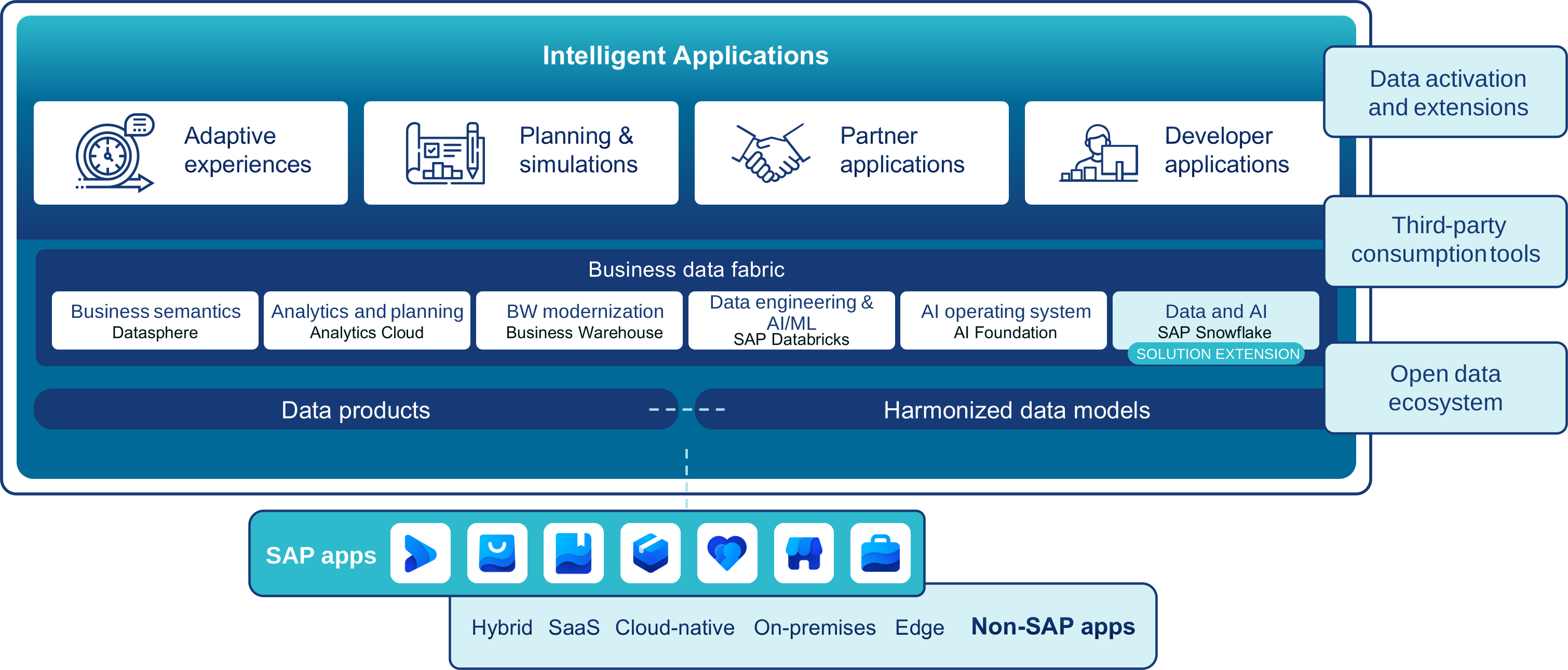
Architecture & Components at a Glance
SAP Business Data Cloud consists of several core components that are tightly integrated and together form a powerful data platform.
SAP Analytics Cloud (SAC)
SAP Analytics Cloud is the component used for optimal data visualization and analysis. In addition, it serves as the central planning tool for cross-functional planning and data simulation.
SAC does not have to be used in conjunction with the solutions shown here or the BDC platform; it can also be deployed independently. In such scenarios, the analytics and planning data models reside within SAC itself or in connected data sources such as SAP S/4HANA or SAP IBP.
SAP Datasphere
SAP Datasphere is considered the successor to SAP BW in the context of BW modernization. It enables, for example, the simulation of data flows and the semantic modeling of data structures. In addition, compared to SAP Analytics Cloud, it offers enhanced visualization capabilities in the context of data modeling, such as the representation of data flows, dependencies, and relationships between data objects. This means that SAP Datasphere can be used to create entity-relationship models (ERMs)—graphical models based on standard ER notation that represent semantic entities such as sales orders and production orders, as well as their relationships. For example, a single sales order can be linked to multiple production orders.
For customers using SAP BW, the Business Data Cloud in combination with SAP Datasphere provides a pathway to modernize existing systems with minimal cost and risk. For instance, organizations can store historical BW data as data products in the BDC, allowing only active data to remain in SAP BW and reducing costs. Once transformed into modern data products, BW data can also be used for analysis with AI applications.
The integration of SAP Analytics Cloud and SAP Datasphere is enabled via a live connection. This ensures real-time data availability for immediate analysis and visualization. The close integration of SAC and Datasphere is often referred to as “Seamless Planning.” For example, changes to master and transactional data in SAP Analytics Cloud are automatically synchronized with SAP Datasphere, eliminating the need for manual imports and exports.
Databricks and Open Data Ecosystems
Databricks plays a key role in the integration and processing of unstructured data such as emails or images. SAP Databricks within the Business Data Cloud enables different types of data to be linked and combined without creating duplicates. Using SQL and Python, large volumes of unstructured data can be analyzed efficiently. In particular, Python can be used to build AI and machine learning applications to generate additional insights from the data.
A distinction is made between:
- Databricks as a partner solution
- SAP Databricks (Embedded Databricks)
In addition, further partners are gradually being integrated into the ecosystem, such as Snowflake or Microsoft Business Data Fabric.

With SAP Business Data Cloud, SAP provides a powerful data platform that brings together SAP and non-SAP data into a unified, trusted foundation. We are happy to support you in making the most of your data and enabling faster, well-informed, data-driven decisions.
Typical Use Cases of SAP Business Data Cloud
SAP BDC supports a wide range of use cases and provides a comprehensive, strategic-level view across the entire organization.
Typical use cases include:
- Harmonization of the data landscape
- Discovering data relationships (data mining)
- Data modeling across multiple systems
- Development of AI and machine learning models
- Enterprise planning and business intelligence
- Data governance and compliance
- Development of intelligent applications to support all business processes
Concrete examples:
- Which products are frequently purchased together?
- Which regions are particularly profitable based on data from multiple systems?
- What market opportunities exist in specific regions?
- Which economic or climate developments are impacting the business?
- What risks and opportunities arise from external data sources?
Business Data Cloud supports users in a wide range of roles across the organization in their daily work:


Our Services Around SAP Business Data Cloud
Based on our proven approach “SAP Activate – tailored by CONSILIO,” we support you in the implementation and use of SAP Business Data Cloud—from strategy through to successful execution.



Common questions about SAP Business Data Cloud (FAQ)
What is the difference between SAP Business Data Cloud and SAP Analytics Cloud?
SAP Analytics Cloud is a component within the data architecture, focusing on analytics, reporting, and planning. SAP Business Data Cloud, on the other hand, is the overarching data platform that harmonizes data from SAP and non-SAP sources and makes it available for analytics and AI applications.
Can I use SAP Analytics Cloud without Business Data Cloud?
Yes, SAP Analytics Cloud can also be used independently. In this case, analytics and planning data models reside directly within SAC itself or in connected data sources such as SAP S/4HANA or SAP IBP.
Is SAP Business Data Cloud only relevant for SAP S/4HANA?
No, SAP Business Data Cloud integrates both SAP and non-SAP data sources and therefore supports an enterprise-wide data strategy across system boundaries.
Which data sources can be integrated?
SAP Business Data Cloud processes both structured and unstructured data from a wide range of systems—including external platforms and data sources, as well as images and emails.
How does SAP Business Data Cloud ensure consistent and trusted data?
SAP Business Data Cloud harmonizes SAP and non-SAP data within a unified semantic layer, providing trusted data for analytics and AI. In addition, the platform uses a unified domain model to harmonize business entities across all SAP applications and ensure consistent metadata.
How quickly is data available in SAP Business Data Cloud?
SAP Business Data Cloud provides an SAP-managed, subscription-based service with real-time data replication from SAP applications. This reduces data preparation efforts and significantly shortens time to insight.