Universal Journal
With the introduction of SAP S/4HANA, SAP has fundamentally changed the architecture of Finance and Controlling. The Universal Journal — table ACDOCA — is at the heart of this new data structure. In this FAQ article, we answer the most common questions about the Universal Journal.
Never miss another update
What does ACDOCA stand for?
The abbreviation stands for:
AC = Accounting
DOC = Document
A = Actuals
ACDOCA therefore stands for “Accounting Document – Actuals.”
What is the Universal Journal?
The Universal Journal is the central database in SAP S/4HANA that combines Financial Accounting (FI), Controlling (CO), the Material Ledger, Asset Accounting (AA), and Profitability Analysis (CO-PA) into a single table.
Instead of storing data multiple times in different tables, the Universal Journal consolidates all relevant information in table ACDOCA — using a unified data model for financial accounting and management accounting.
What data is stored in the Universal Journal?
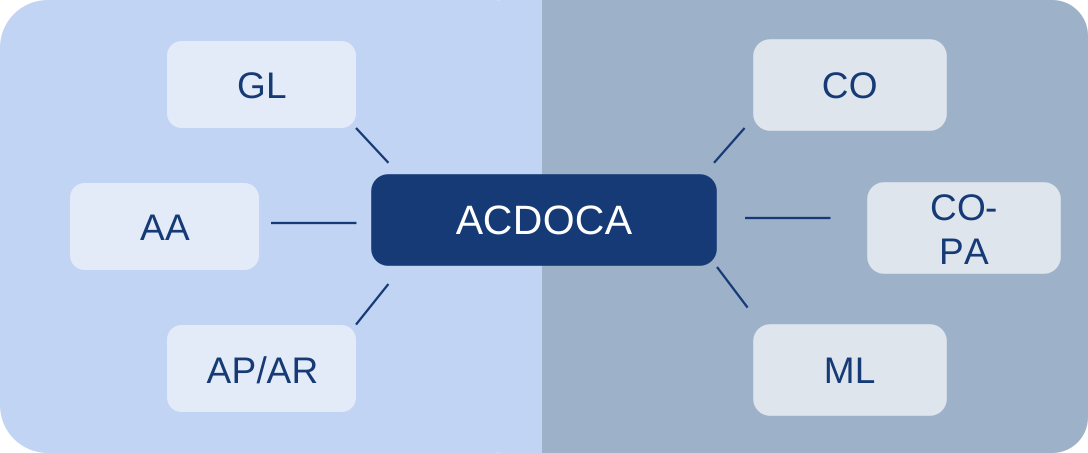
The Universal Journal stores all transaction data from various financial and controlling areas. These include:
- General Ledger (GL)
- Asset Accounting (AA)
- Accounts Payable / Accounts Receivable (AP/AR)
- Overhead Controlling (CO)
- Profitability Analysis Data (CO-PA)
- Material Ledger (ML)


Thanks to CONSILIO, we were able to establish a globally standardized controlling framework at our largest European locations and successfully harmonize our CO processes and master data.
What are the benefits of the Universal Journal?
- Integration of FI and CO: FI and CO are fully integrated: one document — one truth
- Single source of truth: All relevant FI and CO transaction data is centralized in a single table
- Flexible reporting: Customizable and granular analysis options
- Transparency and traceability: Real-time analyses and drill-downs down to the document level
- Faster closing: No more reconciliation activities required between FI and CO
How does the Universal Journal differ from the traditional tables in SAP ERP
(e.g., BSEG, COEP, FAGLFLEXA)?
In SAP ERP, financial and controlling data were stored in separate tables, such as:
- BSEG for FI documents
- COEP for CO documents
- FAGLFLEXA for the New General Ledger
As a result, the same data was often maintained in parallel across multiple tables. This led to data redundancy and a high volume of reconciliation work between FI and CO.
The Universal Journal in S/4HANA replaces these structures with a single, unified table (ACDOCA) that contains all relevant dimensions — thereby integrating FI and CO both technically and in terms of content.
Will the old tables still be available?
Yes — many of the classic tables still exist, but they are technically redirected to the Universal Journal (ACDOCA).
SAP uses what are known as compatibility views, which ensure that older programs, reports, or custom developments continue to function even though the data is now stored physically only in ACDOCA.
Can you create your own fields or extensions in Universal Journal?
Companies can add their own fields (known as custom fields) to the Universal Journal.
The extensions are implemented to be HANA-compatible, so they can also be used in reporting, CDS views, and Fiori apps — without requiring traditional programming.
What impact does the Universal Journal have on performance and reporting?
Thanks to the SAP HANA database, all transactions are stored in a column-oriented, in-memory format.
This enables:
Lightning-fast aggregations and drill-downs
Real-time reports without pre-aggregation
Elimination of intermediate tables and indexes
Reports that used to take minutes or hours to generate can now be produced in seconds.
In addition, analytical tools such as SAP Fiori apps or Embedded Analytics benefit directly from this performance.

ACDOCA combines finance and controlling in a single central database — reducing the effort required for reconciliation and speeding up reporting.
What new reporting options are made possible by combining FI and CO data?
This integration opens up new possibilities:
Finance and controlling data are retrieved from a central data source — in real time. Users can leverage this data pool and, with the help of various Fiori apps, easily create multidimensional reports to precisely meet their current reporting needs.