


SAP S/4HANA Transformation
Your custom roadmap for the transition to S/4HANA
There is no way around SAP S/4HANA.
The clock is ticking: SAP will end mainstream maintenance for SAP ERP 6.0 (ECC) at the end of 2027. Extended maintenance for ECC will only be available until 2030, or under certain conditions until 2033. While SAP S/4HANA can still be deployed on-premise, SAP’s strategic direction is clearly centered on the cloud. As part of their S/4HANA transformation journey, organizations should therefore evaluate whether a full or partial migration of their system landscape to the cloud is the right step forward.

RISE with SAP
We are certified Partner.
RISE with SAP is aimed at companies using an SAP ERP system that want to migrate to an SAP Cloud ERP.








Successful S/4HANA transformation at VOSS
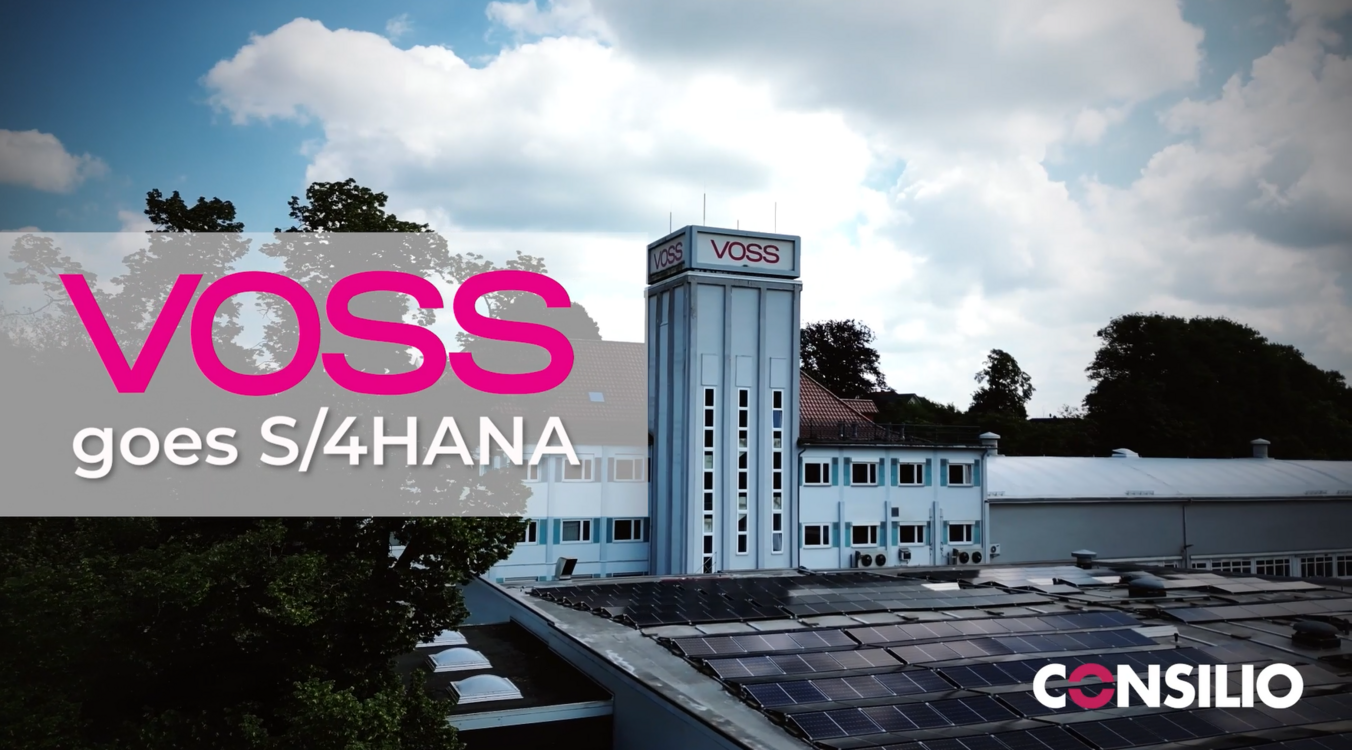
VOSS Automotive has successfully carried out a comprehensive S/4HANA transformation with CONSILIO – on schedule, within budget and within the planned scope of the project.
In the project video, Sacha Dannewitz, Vice President IT & Digitalisation at VOSS, explains the reasons for choosing the cross-field approach, the biggest challenges during implementation and the factors that contributed to the smooth collaboration with CONSILIO.
Getzner Werkstoffe successfully masters its S/4HANA transformation with CONSILIO as its partner.
In this short video, you will learn why Getzner Werkstoffe opted for an S/4HANA Greenfield implementation and what factors contributed to the successful S/4HANA transformation. In our video, the project team from Getzner Werkstoffe and experts from CONSILIO report first-hand on the challenges, successes and lessons learned during the project.


We equip our customers for the digital world.
With the real-time ERP suite S/4HANA.
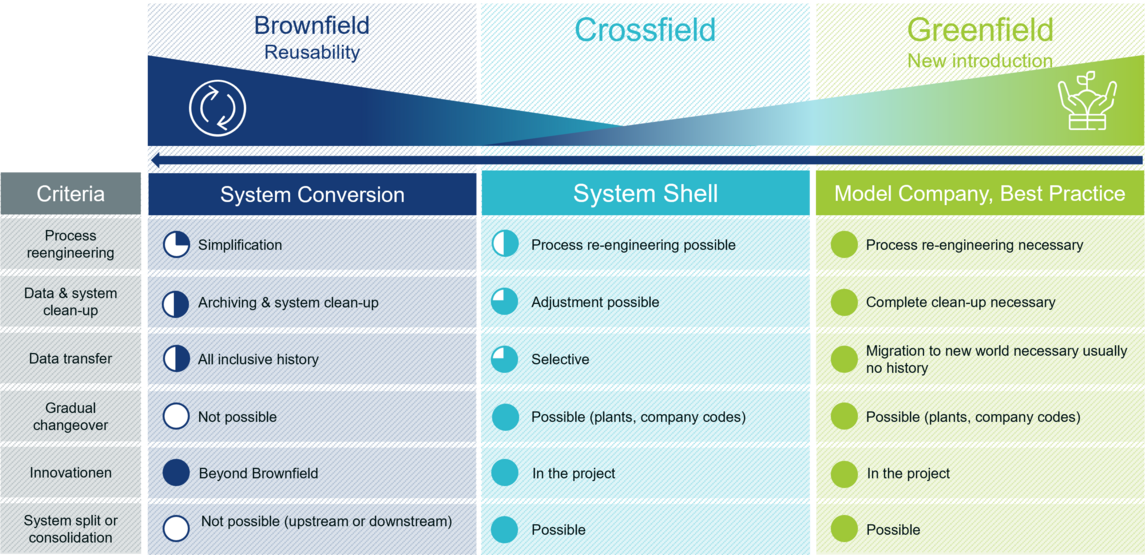
Switching to S/4HANA - migration paths to your digital business
With SAP S/4HANA, you are setting the course for the future. But how can you successfully migrate to the new environment? What migration paths are there and which approach is right for your company?


SAP S/4HANA Architecture Options Compared
SAP’s strategic direction is clear: the future of S/4HANA is cloud-first, with a strong emphasis on the Public Cloud. While on-premise systems remain supported, innovation delivery is increasingly limited. Our recommendation: Organizations should set the course toward the cloud at an early stage to benefit from innovation and ensure long-term future viability.
| On-Premise | SAP Cloud ERP Private (Private Cloud) | SAP Cloud ERP (Public Cloud) | |
| Characterization | Use of the on-premise software version under full customer responsibility. | Use of the on-premise software version provided as an SAP-managed service | Use of the SAP cloud software version as Software as a Service (SaaS). |
| Operations | Operated by the company in its own data center or via a hosting partner. | Operating system and databases are managed by SAP. The system runs with a hyperscaler selected by the customer in a dedicated environment. | Fully managed by SAP. Use of the Public Cloud software version within a dedicated tenant. |
| Innovation Capability | New SAP innovations (e.g., AI, sustainability, embedded analytics) are often delivered with significant delay or not at all. SAP’s strategic investments are no longer focused on on-premise solutions. | Faster innovation cycles compared to on-premise. Some innovations may be delivered with limitations or delays. | Fastest access to new SAP innovations, although often based on a reduced functional scope. Continuous, automatic updates. SAP investments and new features are primarily rolled out here. |
| Customization | Very high degree of flexibility through enhancements, custom code, and, if necessary, modifications. | Flexible customization while adhering to SAP Clean Core principles. | Significantly reduced customization within the framework of Public Cloud extensibility. |
| Implementation Approach | Greenfield, Brownfield, Crossfield | Greenfield, Brownfield, Crossfield | Greenfield only |


Accelerated SAP Transformations with AI – Consistently Enabling Clean Core
Together with CONSILIO, Nova Intelligence brings agent-based artificial intelligence into SAP transformation projects. The goal is to significantly simplify the path to SAP S/4HANA – making transformations faster, more transparent, and fully aligned with SAP’s Clean Core strategy.
Nova Intelligence’s AI platform automatically analyzes existing SAP systems and custom developments. AI agents assess custom code, evaluate its Clean Core readiness, and make the existing codebase accessible through natural-language queries.
In close combination with CONSILIO’s SAP expertise, this enables:
- Reliable decision-making foundations for S/4HANA conversions and greenfield approaches
- Structured, automated documentation of existing SAP landscapes
- Clear recommendations for refactoring, decommissioning, or relocating extensions
- A sustainable Clean Core architecture with future-proof extension concepts (BTP, side-by-side)
The result:
Less manual analysis effort, significantly faster project execution, and a clean, maintainable SAP architecture without functional compromises.
Nova Intelligence and CONSILIO demonstrate how AI-driven analysis and deep SAP process and technology expertise can be combined to deliver S/4HANA transformations efficiently, with reduced risk, and in a sustainable way.
Learn more in our webinar “SAP S/4HANA Transformations & Clean Core – Accelerated with AI Agents”.

RISE or GROW? Two Paths to SAP S/4HANA in the Cloud
At the beginning of 2025, SAP revised the terminology for GROW with SAP and RISE with SAP. Unlike in the past, the distinction is no longer based on whether a company chooses SAP S/4HANA in the Public Cloud or the Private Cloud.

Transitioning to S/4HANA – Frequently Asked Questions
What happens if I only migrate to SAP S/4HANA after 2027?
As of December 31, 2027, mainstream maintenance for SAP ERP 6.0 (ECC) will end. After that date, companies must rely on paid Extended Maintenance until 2030, or in certain cases until 2033. Organizations that do not migrate to SAP S/4HANA in time may continue to operate their systems at their own responsibility. However, SAP will no longer provide bug fixes, security patches, legal updates (e.g., changes affecting payroll or social security contributions), or new functionalities. This significantly increases security risks. In addition, the lack of updates may lead to compliance and audit issues, for example, if payroll calculations are no longer legally accurate due to missing regulatory adjustments.
What are the risks of an SAP S/4HANA transformation?
The following factors frequently cause challenges in transformation projects:
- Unclear target vision and strategy
- Insufficient change management
- Poor data quality
- Resource constraints
- Lack of effective project governance
These issues can result in higher costs, longer project timelines, and low user acceptance of the new system.
A good first step to mitigate these risks is conducting an SAP S/4HANA assessment with an experienced consulting partner such as CONSILIO.
Is it possible to combine SAP S/4HANA On-Premise and Cloud?
Yes. Hybrid landscapes are a well-established approach that enables the parallel operation of on-premise and cloud systems. For example, companies may continue to run core production components locally, while other processes, such as Finance, Procurement, Sales, or Analytics, are already operated in the cloud. This approach increases flexibility and reduces transformation risks.
What is new in SAP S/4HANA compared to SAP ECC?
SAP S/4HANA is built on the SAP HANA in-memory database and introduces numerous innovations, including:
Procurement
- Self-service procurement
- Accelerated approval processes using Flexible Workflows
- Supplier evaluations based on hard and soft facts via SAP Fiori apps
Finance & Controlling
- Universal Journal (“single source of truth” approach)
- Parallel accounting
- More efficient and partially predictive credit decision processes
Asset Management
- More accurate maintenance and downtime planning based on real-time data
- SAP Fiori apps for resource scheduling
- Ability to check material availability for multiple orders simultaneously
Overall, SAP S/4HANA is significantly more powerful, faster, and more intuitive than traditional SAP ECC.

Very important for the success of any S/4HANA transformation is that the FI/CO team - both the business and the IT side - is part of the project from the very beginning.






S/4HANA Assessment

With SAP S/4HANA, you set the course for the future. But how can you successfully transition to the new environment? How can you best prepare for the transformation? And what costs should you expect?
We are happy to advise you as part of a comprehensive SAP S/4HANA Assessment.

Migration tools for S/4HANA



Kyano® CrystalBridge
CrystalBridge is a transformation platform by SNP Group for analyzing, planning, and executing SAP transformations, particularly in the context of selective data migrations and system consolidations.

Lean Selective Data Transition
Lean Selective Data Transition is an approach defined by SAP for the structured execution of selective data migrations, with the objective of reducing the relevant data volume to business-critical information.
Innovations with SAP S/4HANA
SAP S/4HANA transformation enables you to leverage innovations across multiple business areas, such as Logistics or Manufacturing. Whether it’s automated procurement workflows, real-time transparency in Finance, intelligent demand planning in Logistics, or AI-supported sales planning: SAP S/4HANA brings a wide range of new capabilities.
In our Trend Blog, you’ll find regular updates on innovations across different functional areas. Through our webinars and events as well as our video library, we provide in-depth insights into individual solutions and features.
